PROGNOSIS: a ratio ≤38 rules out preeclampsia for one week
Negative predictive value 99.3% for no preeclampsia within one week. The basis of the rule-out threshold used in guidelines.
Read the publication ↗MOMM Diagnostics is pioneering rapid, point-of-care testing to identify preeclampsia earlier, giving clinicians the insight they need to protect mothers and babies.
Preeclampsia affects 2–8% of pregnancies. Clinicians decide on blood pressure and urine protein, which predict poorly. Lab tests are accurate, but their results often come back too late to be actionable.
Built for the moment a decision is needed.
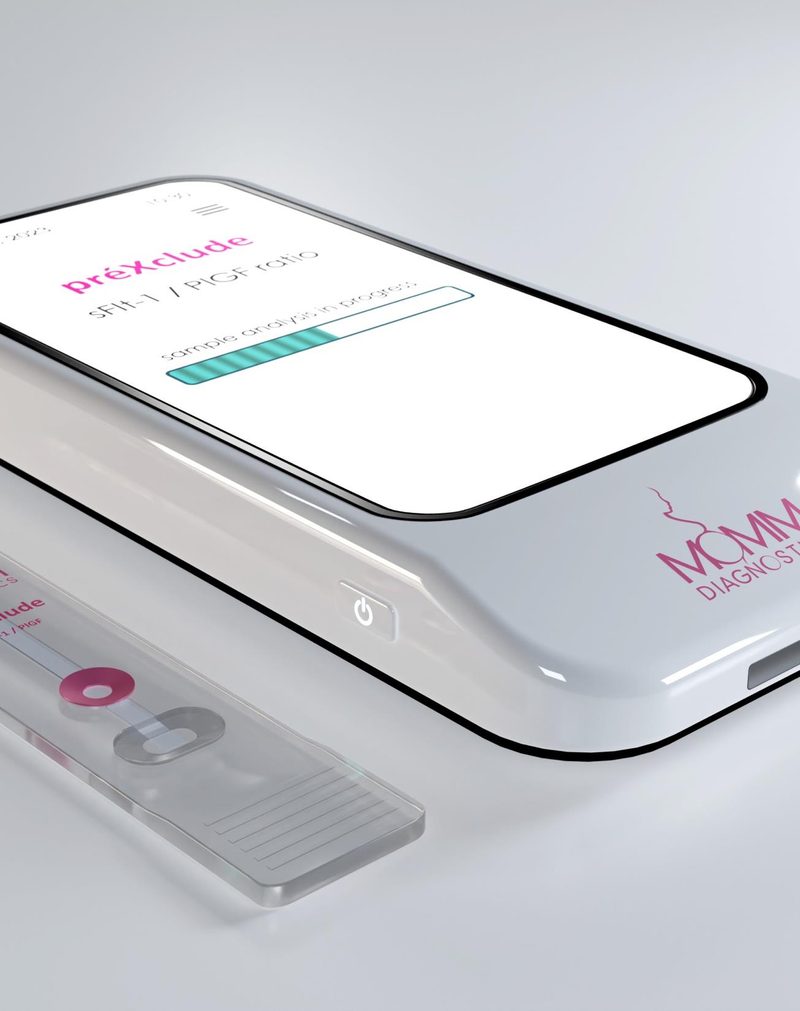
préXclude® gives obstetricians and midwives an objective, reliable reading from a single fingerprick to help diagnose preeclampsia, so they can make the best decision for mother and baby in minutes, not hours.

The sFlt-1/PlGF ratio is endorsed by ISSHP, NICE and FIGO, with evidence that it improves care and outcomes and saves costs.
Clinical evidence →Our patented technology brings it to the place and time a result is needed.
How préXclude® works and scales →Growing to USD 1.5–5.8B by 2032–2034. Range of five independent market reports.TechSci · Straits · Grand View · Market.us · Coherent
FDA-cleared lab tests and Medicare payment for the sFlt-1/PlGF ratio are already in place.Straits Research, 2025
All pregnant women with suspected preeclampsia, in any care setting, not only hospitalized women. Unique to préXclude®.MOMM bottom-up: 3.6M births × 29% with signs of preeclampsia (Khosla 2024) × USD 100 MOMM revenue per test (USD 250 target reimbursement).
Platform upside: the same reader runs further maternal tests (fetal growth restriction, preterm birth, maternal sepsis). The global maternal & neonatal point-of-care diagnostics market is projected to reach USD 1.7B by 2030 (Virtue Market Research).
| Approach | Actionable for patient management | Point of care | Time to result | Use |
|---|---|---|---|---|
| préXclude® (MOMM) | Yes: guideline-endorsed sFlt-1/PlGF ratio, rule-out / rule-in during the visit | Yes | ~25 min | Rule-out / rule-in at presentation, all settings |
| Central-lab ratio (Roche, Thermo Fisher) | Too late: result comes after the admit-or-discharge decision | No | 3 h to >1 day | Hospitalized women, 23–34+6 wks |
| Other point-of-care tests (Lumella, Triage PlGF, Lepzi) | No: biomarkers available on point-of-care tests are not guideline-endorsed | Yes | Minutes | Not available in the U.S. |
| Liquid biopsy (Mirvie, Aitiologic, iPremom) | No: useful to establish future risk, not for a triage decision now | No | Days (send-out lab) | Early risk screening, complementary |
MOMM forecast: U.S. launch in H1 2030, Europe and the rest of the world from 2031, pipeline tests on the installed readers from 2032; EBITDA breakeven in 2033. Financial plan by market →
Hypertensive disorders complicate 1 in 7 U.S. deliveries, and women with preeclampsia are about 4 times more likely to suffer serious complications. Yet the best-validated test stays in hospital labs. préXclude® brings it to doctors' offices, outpatient clinics and rural care, with support from the Gates Foundation.
Clinical evidence →One connected reader and a growing cartridge menu: preeclampsia first, then fetal growth restriction, preterm birth and maternal sepsis. Ideally positioned to deliver a comprehensive portfolio of lab-grade diagnostic tools for maternal health at the point of care.
Platform and pipeline →Medical device and diagnostics developers with clinical user experience, a board that has built, registered and launched MedTech and diagnostics products in the U.S., Europe and Asia, and advisors from Roche Diagnostics, Abbott and Alere with experience doing what MOMM needs to do next.


No mother should suffer or lose her child because of a preventable delay in diagnosis. We are raising a USD 10M Seed round to take préXclude® from a verified prototype through a U.S. pivotal study to FDA submission.
Mathias Wipf, PhD, CEO & Co-founder · mathias.wipf@mommdiagnostics.com
We are raising a USD 10M Seed round to take préXclude® from a verified prototype through a U.S. pivotal study to FDA submission.
The USD 10M Seed round turns a feasibility-stage product into an FDA-submission-ready one. Gates refer to the milestone plan.
| Today | After the Seed | |
|---|---|---|
| Product | Feasibility stage: Alpha prototype validated in a clinical feasibility study with 123 pregnant women; Beta prototype in verification | FDA-submission-ready, design-locked product, verified on 3 production lots (G3–G4) |
| Analytical | Fingerprick plasma verified against venipuncture plasma (46 paired samples). On-board plasma separation and metering from 50 µL whole blood. Quantification of sFlt-1 (100–20,000 pg/mL) and PlGF (20–10,000 pg/mL); time to result ~30 min | Full analytical performance to CLSI guidelines (international lab standards recognized by FDA), validated against the FDA-cleared lab test for 50 µL capillary whole blood or plasma; walk-away operation with ≤25 min time to result (G1, G4) |
| Clinical | PRETECH clinical feasibility study at Kantonsspital Baden (ISRCTN31137599), validating capillary sampling and the analytical performance of the préXclude® Alpha prototype | PREVENT-PE Rwanda pilot results; cut-off and clinical performance set on biobank samples (e.g. PRO-129, PRAECIS); U.S. pivotal study with ~500 pregnant women, rule-out target: ≥97% of negative results correct (negative predictive value, NPV) (G3–G5) |
| Regulatory | FDA Pre-Submission filed; FDA meeting 1 December 2026 | FDA-aligned pivotal protocol (G2); De Novo and CLIA waiver submitted; IVDR technical documentation ready for the CE application (G5) |
| Manufacturing & quality | In-house production of up to 2,000 test kits per month; transfer of individual components to a contract manufacturer (FlexMedical Solutions); quality system built to ISO 13485 | Scaled manufacturing (automated roll-to-roll production and assembly) at the contract manufacturer, >100,000 tests per month; process and unit costs validated; ISO 13485 certified (G2–G4) |
| Commercial | KOL network and U.S. reimbursement strategy | Customer letters of intent, distribution-partner term sheet, PLA code application ready (G3–G5) |
MOMM is raising a USD 10M Seed in two tranches of USD 5M. Tranche 1 (Q2 2027) funds Beta verification, the FDA-aligned pivotal protocol and design for manufacturing. Tranche 2 (Q2 2028) is released at design freeze and funds the U.S. pivotal study and ISO 13485 certification (milestone gates and costs).
A Series A of USD 15M+ at the FDA submission (target Q3 2029) funds FDA authorization, the U.S. launch in H1 2030, menu expansion and international markets. In the financial plan, préXclude® in the U.S., Europe and the rest of the world plus the pipeline tests reach USD 57.3M net revenue and USD 36.0M EBITDA in 2034, with EBITDA breakeven in 2033 (financial plan, revenue plan).
MOMM is built as an acquisition target for diagnostics and women's-health companies, with a strategic exit targeted for 2033.
Term sheet, cap table, financial model and return scenarios are available in the data room on request.
Two FDA-cleared lab tests (2023, 2025) prove the sFlt-1/PlGF ratio, and no point-of-care version exists yet. MOMM's FDA Pre-Submission was filed in September 2026, with the FDA meeting on 1 December 2026: Seed investors enter as the pathway is confirmed.
Regulatory pathway →ACOG's 2024 Clinical Practice Update supports the ratio for hospitalized women, and Medicare already pays for the lab test. The missing pieces are outpatient evidence and a result where and when the decision is made.
Reimbursement →A ~USD 100M U.S. beachhead within a USD 411M U.S. and USD 1–2B global preeclampsia diagnostics market, with a maternal test menu to follow on the same reader.
Market →Book a call with Mathias Wipf, PhD, CEO & Co-founder, for the investor deck, data room access and a walk-through of the plan.
Figures marked as draft or target are forward-looking and not guarantees of future results.
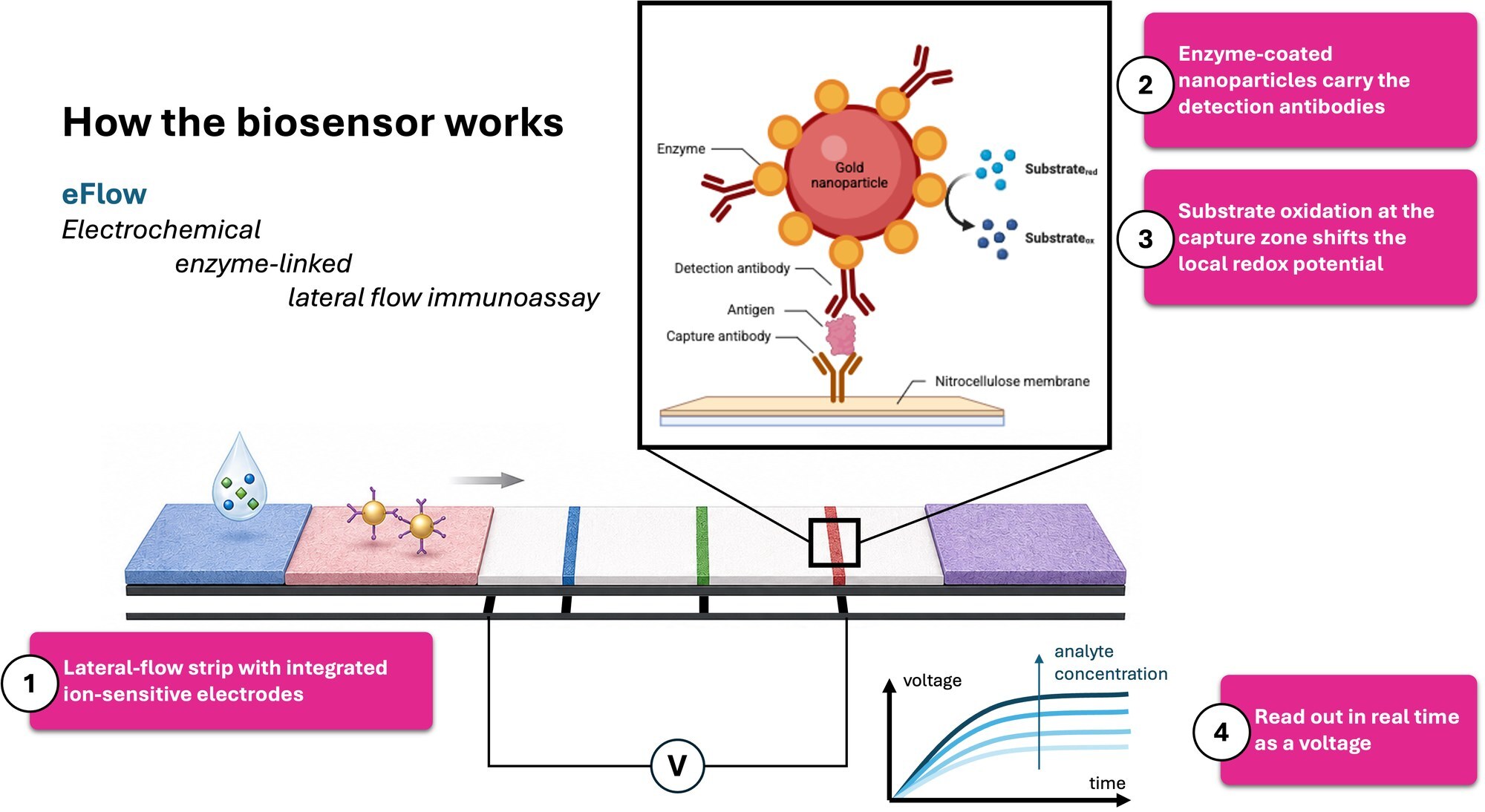
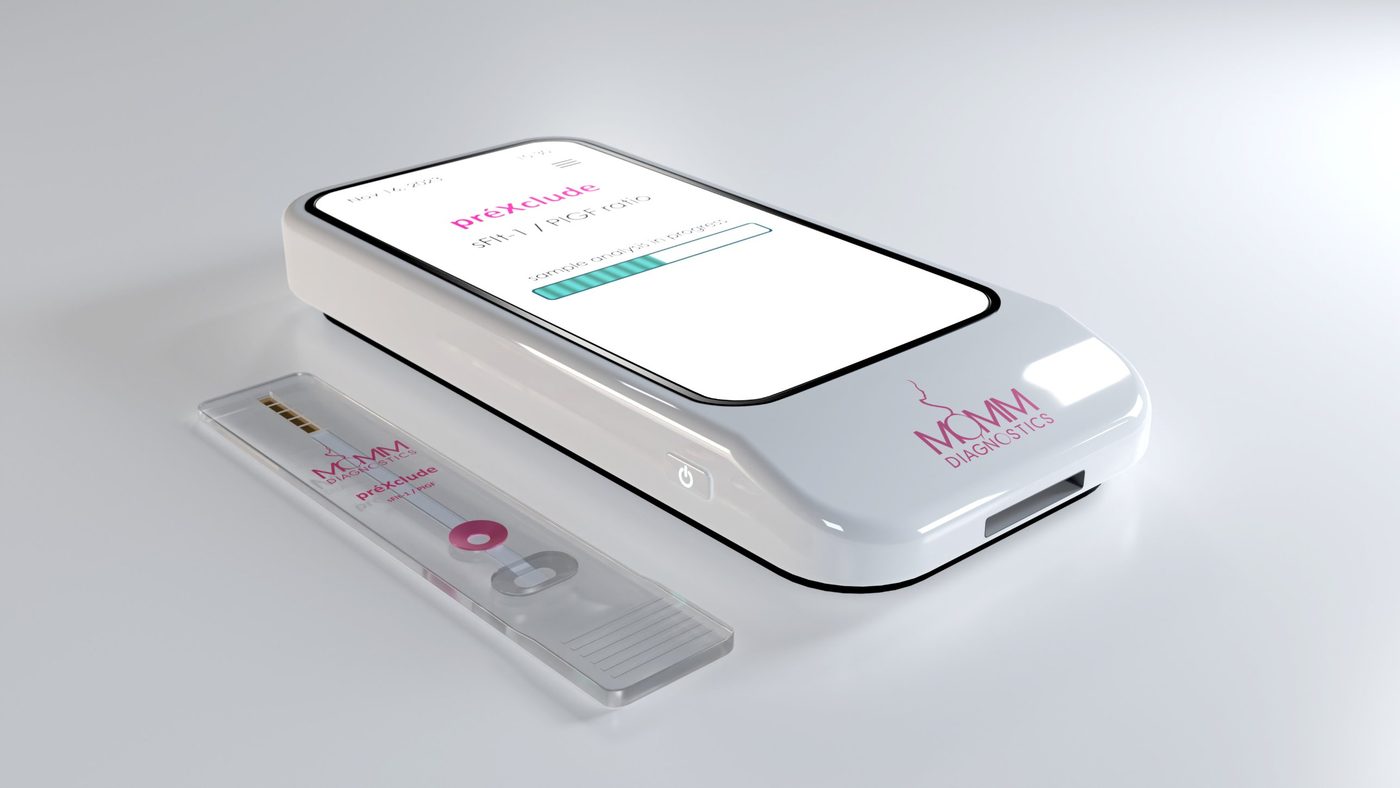
préXclude®, MOMM's rapid preeclampsia test, is built on eFlow, MOMM's patented electrochemical lateral flow technology. eFlow keeps the lateral flow strip used in pregnancy and COVID-19 rapid tests and adds integrated electrodes. The strip stays cheap and mass-producible, but the result is a precise number instead of a visual line.

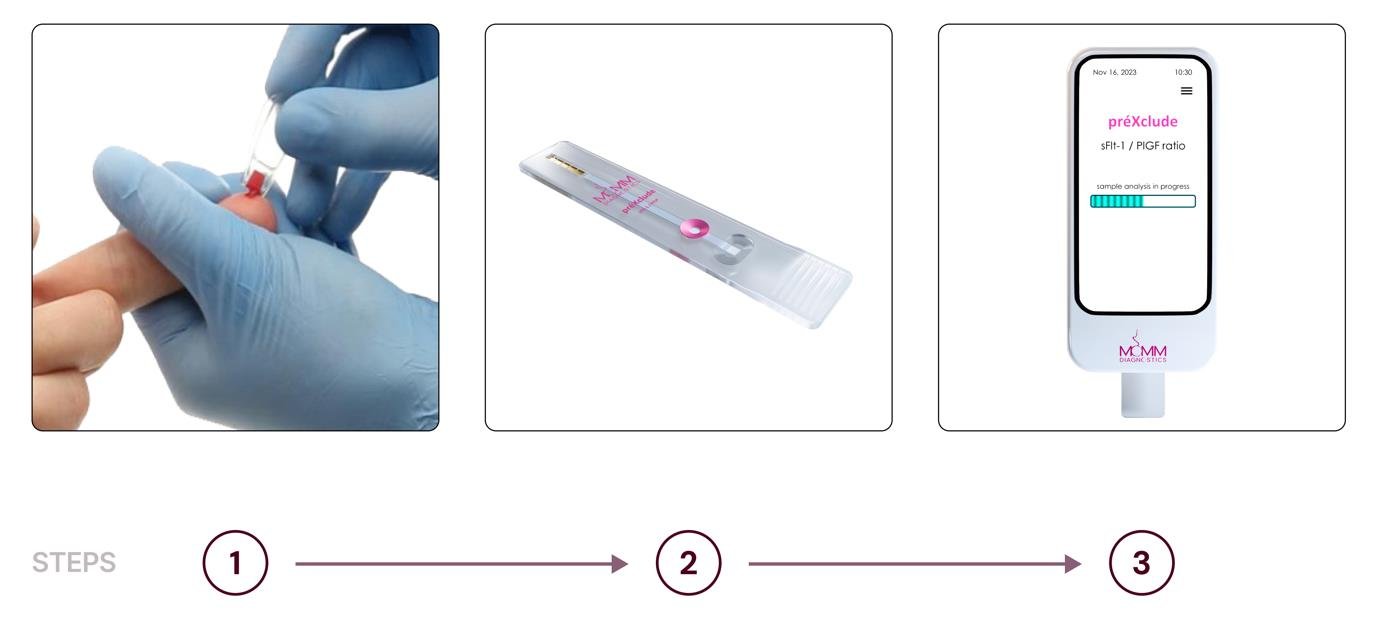
50 µL from a fingerprick goes onto the cartridge. The cartridge separates and meters the plasma, so no centrifuge or lab step is needed.
Antibodies on the test strip capture the target proteins sFlt-1 and PlGF. An enzyme label multiplies the signal, which gives up to 100× lower detection limits than standard lateral flow.
Electrodes printed into the strip measure the signal. The reader turns it into concentrations and the sFlt-1/PlGF ratio, with no optical reader and no subjective line reading.

Lateral flow is the most scaled diagnostic format in the world: billions of strips per year were produced on established automated roll-to-roll lines during COVID-19 (the strip material runs continuously through printing, coating and cutting). eFlow uses the same format and adds printed electrodes, a step that also scales on standard printing equipment.
Target cost per test at ≥1M tests per year. Strip production is moving to FlexMedical Solutions, an ISO 13485 contract manufacturer in the UK.
A portable, battery-powered reader placed with the test contract. Faulty readers are replaced rather than serviced.
Every new eFlow cartridge runs on readers already installed, so each new test sells into an existing base.


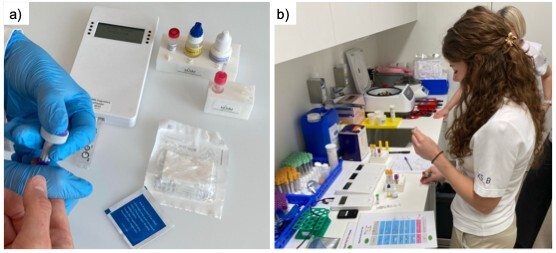
123 pregnant women at Kantonsspital Baden, weeks 10–38 (ISRCTN31137599). Fingerprick blood matched venous plasma on eFlow with no significant bias.
Gates Foundation-funded. Analytical performance verified by Q1 2027; point-of-care operation and clinical data from the Rwanda pilot study by Q4 2027.
Consumable Q4 2027, reader Q1 2028. Pilot lots for the U.S. pivotal study built at the contract manufacturer.
| Feature | Demonstrated (prototype) | Product target (to be proven) | How and when |
|---|---|---|---|
| Sample | 50 µL capillary whole blood from a fingerprick; plasma separated and metered on the cartridge. Fingerprick plasma matched venipuncture plasma (46 paired samples, PRETECH) | 50 µL capillary whole blood or plasma | préXclude® Beta prototype: analytical verification (G1, Q1 2027) |
| Analytical performance | sFlt-1 100–20,000 pg/mL, PlGF 20–10,000 pg/mL; ratio calculated | Quantitative sFlt-1 (400–90,000 pg/mL), PlGF (10–4,000 pg/mL) and the sFlt-1/PlGF ratio; agreement with the FDA-cleared lab test across the clinical cut-offs; precision, measuring range and robustness (e.g. hematocrit) validated to CLSI guidelines | préXclude® Beta prototype: analytical verification (G1, Q1 2027); design verification on 3 lots (G4, Q4 2028) |
| Clinical performance | To be determined: patient samples tested so far without clinical adjudication | Rule-out: NPV ≥97% for no preeclampsia within 7 days; sensitivity ≥80% and specificity ≥75%, in line with the FDA-cleared lab tests (PROGNOSIS, PRAECIS) | PREVENT-PE Rwanda pilot (G3, 2027); biobank samples (PRO-129, PRO-104, PRAECIS); U.S. pivotal study readout (G5, 2029) |
| Time to result | ~30 min; complete workflow, fingerprick to result, run in a hospital setting | ≤25 min | PREVENT-PE Rwanda pilot (G3, 2027) |
| Operation | Alpha: 3 user steps, including pipetting Beta: apply sample and start | Walk-away: apply the fingerprick sample and start the test; the assay runs automatically. Run by clinical staff outside the lab, low test failure rate, usability for the CLIA waiver | PREVENT-PE Rwanda pilot (G3, 2027); CLIA-waiver and human-factors studies (G5, Q1 2029) |
| Calibration | Alpha: batch calibration with manual reader update Beta: lot calibration read from a QR code on the kit | Calibration embedded in the cartridge; no manual setup | Consumable design freeze (G3, Q4 2027) |
| Connectivity | Alpha: standalone operation with USB connection for data transfer Beta: Wi-Fi to a secure cloud that computes the result; results in a browser app | Standalone operation with full connectivity: laboratory-system and electronic health record integration, automated result communication; software updates over the air | Reader design freeze (G3, Q1 2028) |
| Reader | Portable, battery-operated; operating range 18–30 °C | Portable, battery-powered (≥4 tests per charge); reader cost below USD 120 | Reader design freeze (G3, Q1 2028) |
| Storage | 2–37 °C; long-term stability testing ongoing | ≥18 months shelf life without cold chain | Real-time stability (G5, Q2 2029) |
| Manufacturing | In-house production of up to 2,000 test kits per month; individual components transferred to a contract manufacturer (FlexMedical Solutions); standard lateral-flow format | Automated roll-to-roll production of >100,000 tests per month; lot-to-lot reproducibility; unit cost below USD 2 | Process transfer to an ISO 13485-certified contract manufacturer (G2, Q3 2027); pilot lots (G3, Q1 2028); process validation (G4, Q4 2028) |

MOMM's own and licensed patents protect the eFlow platform and its PlGF assay methods.
| Family | Patents | Status |
|---|---|---|
| eFlow immunoassay analyzer and sensor | WO 2021/053206 A1 · EP 4031869 · US 17/753,884 (US 2023/0333118 A1) | Owned · pending |
| PlGF assay methods for preeclampsia | US 11,112,403 · US 11,327,071 · US 18/943,446 · EP 4070113 | Owned · granted and pending, to 2040 |
| Electrochemical sensing | US 9,702,847 B2 · US 9,766,201 B2 (plus EP, CA, JP rights) | Exclusive, royalty-free worldwide license from eSense LLC |
The foundational third-party patents on sFlt-1 and PlGF for diagnosing preeclampsia have expired. Using the ratio for preeclampsia diagnosis is in the public domain; MOMM's protection lies in how préXclude® measures it at the point of care.
| Third-party patent | Holder | Subject | Status |
|---|---|---|---|
| US 7,335,362 B2 | Beth Israel Deaconess Medical Center | sFlt-1, PlGF and VEGF in preeclampsia | Expired 2023 |
| US 7,344,892 B2 | Massachusetts General Hospital, Beth Israel Deaconess Medical Center | Screening for gestational disorders (PlGF, sFlt-1) | Expired 2024 |
| US 8,349,325 B2 | Abbott Laboratories | sFlt-1 antibody and immunoassay | Lapsed |
Maternal health first, with preeclampsia as the beachhead. Market sizes link to their source; bottom-up estimates are marked.
| Application | Biomarkers | Why it fits | U.S. market |
|---|---|---|---|
| Preeclampsia · préXclude® | sFlt-1 / PlGF | Lead product | $411M (2025) |
| Fetal growth restriction | sFlt-1 / PlGF | Same analytes and ratio, lowest added development (Gaccioli et al., Lancet Child Adolesc Health 2018; Byrne et al., BJOG 2026;133:922–931) | ~$90M* |
| First-trimester screening | PlGF | FIGO-recommended combined screening | $36–72M* |
| Preterm birth | fFN / PAMG-1 / IGFBP-1 | Same clinical users | $49M (2025) – $158M (2022) |
| Maternal sepsis | PCT / IL-6 / CRP | Labor ward and ICU | $256M (2024, all U.S. sepsis diagnostics) |
| Beyond maternal health | Cardiac, infectious disease, consumer | Later platform expansion | — |
* Bottom-up estimates: fetal growth restriction, ~10% of 3.6M U.S. births small for gestational age × USD 250 per test; first-trimester screening, 3.6M births × USD 100 bundled screening × 10–20% uptake. Preterm birth: range of two market reports. Maternal sepsis: total U.S. sepsis diagnostics market, of which maternal use is a part.
A failing placenta releases sFlt-1 and PlGF falls. The ratio rises weeks before blood pressure and protein show it. More than 30 peer-reviewed studies across tens of thousands of pregnant women support it. The key publications are below. They are independent studies of the ratio on central-lab analyzers, not MOMM studies and not of préXclude®; MOMM's own studies are listed at the end of this page.
Preeclampsia develops from week 20. préXclude® is used when it is suspected: a fingerprick during the visit tells the clinician whether she can go home or needs stepped-up care. The same reader can later run screening tests earlier and later in pregnancy.
Gestational weeks. Clinicians need tools to assess preeclampsia in three windows of pregnancy, which gives préXclude® three use cases. The rule-out / rule-in test at presentation is the beachhead (Market page).
Preeclampsia unlikely within the next week: safe to send home.
Higher risk: monitor closely and retest within 1–2 weeks.
Preeclampsia likely: intensify care and plan delivery.
Cut-offs vary with gestational age, population and analyzer platform; the U.S. FDA-cleared lab tests use 38 (Roche) and 40 (Thermo Fisher). Sources: Zeisler et al., NEJM 2016; Stepan et al., Ultrasound Obstet Gynecol 2015.
Negative predictive value 99.3% for no preeclampsia within one week. The basis of the rule-out threshold used in guidelines.
Read the publication ↗A ratio ≥40 predicted progression to severe preeclampsia within two weeks: NPV 96%, PPV 65% (validation cohort). This study underpins the U.S. FDA clearances.
Read the publication ↗At a cut-off of 38: NPV 94.7%, sensitivity 91.4%. AUC 0.92 for the ratio versus 0.74 for standard clinical tests.
Summary and references ↗In women with suspected preeclampsia, a high ratio strongly predicted adverse maternal and fetal outcomes and delivery within two weeks.
Read the publication ↗Established the rule-out, intermediate and rule-in zones of the ratio used in clinical practice.
Find on PubMed ↗Common definitions based on blood pressure and proteinuria have a positive predictive value of about 20% for adverse outcomes.
Find on PubMed ↗Revealed PlGF testing cut time to diagnosis from 4.1 to 1.9 days and reduced severe maternal adverse outcomes.
Read the publication ↗Repeat testing did not improve outcomes further. A single test when preeclampsia is first suspected remains beneficial.
Read the publication ↗Women identified by first-trimester combined screening (including PlGF) who took aspirin had 62% less preterm preeclampsia.
Read the publication ↗Screening by clinical risk factors (NICE) detected 30% of preeclampsia and 41% of preterm preeclampsia; combined screening with PlGF detected 82% of preterm cases.
Read the publication ↗29% of pregnancies had signs or symptoms; only 14% of these were diagnosed. Women with suspicion only cost on average USD 6,096 more, mostly from antenatal admissions and emergency visits.
Read the publication ↗USD 2.18B in the first year around delivery, split between mothers (USD 1.03B) and infants (USD 1.15B).
Read the publication ↗Economic evaluations of the sFlt-1/PlGF test in suspected preeclampsia consistently found it cost-saving.
Read the publication ↗Adding the ratio cut false-positive triage results from 42% to 4%, saving USD 540–1,215 per woman tested.
Read the publication ↗Randomized trials that revealed central-lab results showed mixed effects on admission rates (INSPIRE 2019, PRECOG 2025). A result available at the bedside during the visit is what préXclude® adds; MOMM's U.S. study will measure the effect on admissions directly.
Includes angiogenic imbalance (e.g. the sFlt-1/PlGF ratio) as a sign of placental dysfunction in diagnosing preeclampsia, and supports angiogenic testing to help rule out preeclampsia when it is suspected. Magee et al., Pregnancy Hypertension 2022.
Recommends PlGF-based tests, including the sFlt-1/PlGF ratio, for suspected preterm preeclampsia, weeks 20–36+6.
Recommends first-trimester screening for all women, combining risk factors, blood pressure, uterine artery Doppler and PlGF (FMF algorithm).
Clinical Practice Update following the FDA clearances: the ratio may aid short-term risk assessment for severe preeclampsia in hospitalized women at weeks 23–35, alongside clinical criteria. Not yet endorsed for outpatient use or for diagnosis.
Alpha prototype verified in 123 pregnant women, weeks 10–38, at Kantonsspital Baden. Data available on request (publication in preparation).
300+ women with the Beta prototype. Gates Foundation-funded, with Swiss TPH. Rwanda FDA waiver granted September 2026.
~500 outpatients at ~10 sites in the U.S. and Europe on the design-locked product, with the cut-off set beforehand on banked PRAECIS samples.
Analytical and clinical validation are required for FDA and CE approval. Clinical utility is shown after launch and drives reimbursement.
| Stage | Objective | Studies | Timing |
|---|---|---|---|
| 1 · Analytical validation Required for FDA / CE | Reliable measurement | Beta verification; design verification on 3 lots to CLSI guidelines: precision, linearity, detection limit, interference, comparison with the FDA-cleared lab test | Q1 2027; Q2–Q4 2028 |
| 2 · Clinical validation Required for FDA / CE | Diagnostic performance in outpatients | Cut-off set on biobank samples (e.g. Progenity studies PRO‑105 and PRO‑129, PRAECIS); PREVENT-PE Rwanda pilot; U.S. pivotal study with ~500 outpatients at ~10 sites: sensitivity, specificity, NPV (rule-out target ≥97%) and PPV for preeclampsia with severe features within 14 days | 2027 – Q1 2029 |
| 3 · Clinical utility After launch · reimbursement | Better clinical decisions | Admissions avoided and time to decision, measured in the pivotal study; health-economic model; post-launch utility study (reimbursement) | 2029–2031 |
Pivotal endpoints to be confirmed with FDA after the Pre-Submission meeting on 1 December 2026.
The FDA has cleared the sFlt-1/PlGF ratio twice. Both clearances are limited to central-lab analyzers, venous serum and hospitalized women. préXclude® is designed for the much larger population seen outside the hospital.
| B·R·A·H·M·S sFlt-1/PlGF KRYPTOR (Thermo Fisher) | Elecsys sFlt-1/PlGF (Roche) | préXclude® (MOMM, in development) | |
|---|---|---|---|
| FDA authorization | De Novo DEN220027, May 2023 | 510(k) K241453, Feb 2025 | Planned submission 2029 |
| Population | Hospitalized for hypertensive disorders of pregnancy | Hospitalized for hypertensive disorders of pregnancy | All settings, incl. outpatient |
| Gestational age | Singleton, 23+0 to 34+6 weeks | Singleton, 23+0 to 34+6 weeks | Same as predicates (singleton, 23+0 to 34+6 weeks) |
| Question answered | Progression to preeclampsia with severe features within 2 weeks | Preeclampsia with severe features within 2 weeks | Rule-out / rule-in at presentation |
| Sample and site | Venous serum, central-lab analyzer | Venous serum, central-lab analyzer | Fingerprick blood at the point of care, plus plasma for laboratory use |
| CLIA status | Laboratory test | Laboratory test | CLIA waiver sought for doctor's office use |
Sources: FDA decision letters linked above. The Roche cut-off of 38 was validated in PRAECIS.
Prospective outpatient evidence on the final product, filed as a De Novo request together with a CLIA waiver, so that one launch covers hospitals and outpatient practices.
Unlisted code 81599 at launch, then a MOMM-specific PLA code (12–18 months), then a CPT Category I code (24–36 months).
Medicare pays USD 128.82 for the central-lab ratio test (code 0482U). This rate covers a send-out lab result.
USD 250 average reimbursement per test for a rapid point-of-care result, with commercial payers and hospital systems as the beachhead. To be confirmed with payers.
Europe: lab-based sFlt-1/PlGF testing is already guideline-endorsed and reimbursed in most European markets, for example the UK (NICE DG49), Germany (statutory insurance since 2019) and Switzerland.
Full reimbursement analysis →Health systems in the U.S., Europe and Japan already pay for sFlt-1/PlGF testing in central labs. préXclude® does not have to prove that the biomarker is worth paying for. It has to earn its own billing code and show that a result during the visit changes decisions and avoids admissions.
All current sFlt-1/PlGF tests are central-lab tests on venous serum. None is a point-of-care test.
| Market | Test / code | Payment per test | Coverage and limits |
|---|---|---|---|
| U.S. · Medicare | 0482U · PERA sFlt-1/PlGF ratio (Mayo Clinic, lab-developed test) | USD 128.82 (national lab fee schedule) | Send-out lab test; result in 1–2 days |
| U.S. · Medicare | 0524U · PreClara sFlt-1/PlGF ratio (Thermo Fisher) | No national rate; priced locally by Medicare contractors | FDA-cleared central-lab test for hospitalized women |
| U.S. · commercial | 0482U / 0524U | Est. USD 200–400 (0482U) | Mixed. Some national payers cover the ratio; others, such as Anthem (policy LAB.00040, Dec 2025), still classify it as investigational. |
| UK · NHS | NICE DG49: Elecsys, DELFIA, KRYPTOR ratios; Triage PlGF | £50–80 (NICE-assessed cost per test, e.g. Triage PlGF £49.58, Elecsys £79.23) | Recommended for suspected preterm preeclampsia, weeks 20–36+6, once per episode |
| Germany · statutory insurance | EBM GOP 32363 | €62.25 | Since October 2019; at most 3× per treatment case |
| Switzerland · basic insurance | Analysenliste 1777.00 | 144 points (≈ CHF 144) | From week 20, for suspected preeclampsia |
| Japan · national insurance | sFlt-1/PlGF ratio | ≈ ¥9,000 | Covered; about 31,000 women a year with suspected preeclampsia (2021 model) |
Outside the U.S., payment per test is about USD 60–175, roughly a quarter to 70% of the U.S. target. In Europe, tests for women in hospital are paid inside the hospital's case rate (DRG) rather than billed separately.
0482U and 0524U are proprietary codes of Mayo Clinic and Thermo Fisher. préXclude® cannot bill them and needs its own code. Their payment levels serve only as a reference.
A CLIA-waived test is billed by the ordering practice or hospital under its own provider number, not by a reference lab. The margin stays where the test is run, which is the main reason to adopt it.
If the pitch is "the same test, faster", payers anchor to the USD 128.82 lab rate. The case is that a result during the visit changes triage decisions and avoids admissions, in settings no lab test reaches.
| Phase | Paid to provider |
|---|---|
| Launch (code 81599, before utility data) | USD 150–180 |
| After utility data and own PLA code | USD 200–300 |
The financial plan uses USD 250 per test as the planning value for reimbursement.
Each test pays the practitioner for running it, the distributor for supply and support, and MOMM for the product. At the USD 250 planning value:
What the practitioner earns after utility data, buying the test kit at about USD 150 through the distributor. Margin is after the kit and about USD 5–10 per test for staff time, QC and consumables.
| Setting | Tests per week | Revenue per test | Margin per test | Margin per year |
|---|---|---|---|---|
| OB/GYN office (3 physicians) | 3–6 | USD 200–250 | USD 40–95 | USD 6–30K |
| L&D triage (community hospital) | 8–20 | USD 220–280 | USD 60–125 | USD 25–130K |
| MFM clinic | 5–12 | USD 220–300 | USD 60–145 | USD 16–90K |
Estimates, assuming a commercial payer mix. Readers are placed under a reagent-rental model, so sites need no capital purchase.
Coding, coverage and guidelines are built in parallel with the regulatory path. Months count from U.S. launch.
Most national payers align coverage with ACOG and SMFM. With a guideline mention, policies follow within 6–12 months; without it, each payer runs its own review over 18–36 months. ACOG's 2024 Clinical Practice Update supports the ratio only for hospitalized women at weeks 23–35, as an adjunct for short-term risk assessment, not for outpatient use. U.S. outpatient data from the préXclude® pivotal study are the route to extending that guidance.
The ratio's clinical value is established (PROGNOSIS, PRAECIS, FDA clearances). préXclude® adds concordance with the cleared lab tests and U.S. data showing that a result during the visit avoids unnecessary admissions safely, followed by a published health-economic analysis.
The test cost sits inside the hospital's case rate. préXclude® competes on cost parity with the fully loaded lab test (NICE: £37–79) plus speed and staff time, not on new revenue. CE (IVDR) certificate expected 2030.
Billing a point-of-care ratio test in an OB practice still has to be clarified: in Germany the existing code sits in the specialist-lab chapter; in Switzerland a practice-lab listing is needed.
Covered under national health insurance, but a small market of about 31,000 suspected cases a year. Entry through a distribution partner.
Sources: MOMM U.S. reimbursement strategy (May 2026); CMS Clinical Laboratory Fee Schedule; payer medical policies; NICE DG49; EBM; Swiss Analysenliste; Hypertension Research 2021. Payment levels and coverage change over time and must be confirmed with payers.
From the global preeclampsia diagnostics market (TAM) to U.S. preeclampsia diagnostics (SAM) and the U.S. beachhead préXclude® enters first (SOM), and beyond preeclampsia.
Growing to USD 1.5–5.8B by 2032–2034. Range of five independent market reports.TechSci · Straits · Grand View · Market.us · Coherent
FDA-cleared lab tests and Medicare payment for the sFlt-1/PlGF ratio are already in place.Straits Research, 2025
All pregnant women with suspected preeclampsia, in any care setting, not only hospitalized women. Unique to préXclude®.MOMM bottom-up: 3.6M births × 29% with signs of preeclampsia (Khosla 2024) × USD 100 MOMM revenue per test (USD 250 target reimbursement).
Five independent market reports put the global market at USD 0.85–2.3B in 2024/25, growing to USD 1.1–5.8B by 2031–2034. The estimates differ mainly in which lab and urine tests they include.
| Market report | 2024/25 | Forecast |
|---|---|---|
| TechSci Research | USD 0.85B (2025) | USD 1.1B (2031) |
| Straits Research | USD 1.08B (2025) | USD 1.46B (2034) |
| Grand View Research | USD 1.25B (2024) | USD 2.73B (2033) |
| Market.us | USD 2.2B (2024) | USD 5.8B (2034) |
| Coherent Market Insights | USD 2.32B (2025) | USD 4.6B (2032) |
The sFlt-1/PlGF ratio is guideline-endorsed and reimbursed as a lab test in most of Europe, for example in the UK, Germany and Switzerland. préXclude® competes on speed and setting. CE (IVDR) certificate expected 2030.
Japan covers the sFlt-1/PlGF ratio under national health insurance. Selected Asian markets will be addressed through distribution partners.
Upside on volume: most preeclampsia deaths occur here. Higher cartridge volumes lower unit costs for every market, improving MOMM's scale and global margins. Grant-funded access (Gates Foundation pilot in Rwanda) builds the clinical base; entry after FDA/CE approval.
USD 411M in 2025 (Straits Research). FDA-cleared lab tests and Medicare payment for the sFlt-1/PlGF ratio show that the U.S. already pays for this decision. Bottom-up, MOMM's three U.S. preeclampsia segments add up to about USD 150–190M in MOMM revenue at USD 100 per test (USD 250 target reimbursement).
| Segment | Who | Calculation | MOMM revenue potential |
|---|---|---|---|
| Diagnosis & prognosis (week 20+) Beachhead | All women with suspected preeclampsia, in any care setting | ~1.0M women × $100 | ~$100M |
| First-trimester screening (weeks 11–14) | All pregnancies; FIGO recommends combined screening, U.S. guidelines (ACOG) expected to follow | 3.6M × $100 × 10–20% | $36–72M |
| Late-pregnancy screening (weeks 35–36) | Pregnancies reaching term | 3.6M × $100 × 5% | $18M |
All pregnant women from week 20 with suspected preeclampsia, in any care setting. Today's FDA-cleared lab tests serve only hospitalized women; préXclude® is designed to serve all of them.
CDC NVSS
The gap between the 29% who raise suspicion and the ~5% who have the disease is the decision préXclude® supports.
Every new cartridge runs on readers already installed and sells to the same obstetric customers. The global maternal & neonatal point-of-care diagnostics market is projected to reach USD 1.7B by 2030 (Virtue Market Research).
The same sFlt-1/PlGF ratio identifies placental growth restriction: the lowest added development effort.Gaccioli et al., Lancet Child Adolesc Health 2018 · BJOG
fFN, PAMG-1, IGFBP-1: the same clinical users in obstetric triage.
PCT, IL-6, CRP: labor ward and intensive care.
Cardiac, infectious disease and consumer tests on the eFlow platform.
The ordering site and the distribution partner keep the difference, which makes the test attractive to offer and to sell. MOMM sells through partners and does not plan its own distribution. At a cartridge cost below USD 2 at scale, MOMM targets a gross margin above 90%.
How reimbursement works →préXclude® is the only quantitative sFlt-1/PlGF ratio test from a fingerprick. Every other approach either has the right biomarker in the wrong place, or the right place with a weaker biomarker.
Roche, Thermo Fisher, and send-out labs such as Labcorp, ARUP and Mayo Clinic. Venous blood and lab analyzers mean hours to several days turnaround: too late for the admit-or-discharge decision. FDA-cleared for hospitalized women only.
Triage PlGF measures PlGF alone; Lumella measures glycosylated fibronectin. U.S. clinicians have no guidelines to act on these biomarkers, and neither test is available in the U.S.
Mirvie, Aitiologic, iPremom: cell-free RNA/DNA send-out tests that screen for later risk. They identify more women who need monitoring, which préXclude® serves.
The guideline-endorsed sFlt-1/PlGF ratio from a fingerprick in about 25 minutes, in any care setting, while she is still there.
| Company / test | Biomarker | Sample | Where | Time to result | Clinical question | Status |
|---|---|---|---|---|---|---|
| MOMM · préXclude® | sFlt-1/PlGF ratio | Fingerprick | Point of care, all settings | ~25 min | Rule-out / rule-in at presentation | In development; U.S. launch 2030 |
| Roche · Elecsys | sFlt-1/PlGF ratio | Venous serum | Central lab | 3 h to >1 day | Severe PE within 2 weeks, hospitalized | FDA-cleared 2025 |
| Thermo Fisher · B·R·A·H·M·S KRYPTOR | sFlt-1/PlGF ratio | Venous serum | Central lab | 3 h to >1 day | Severe PE within 2 weeks, hospitalized | FDA De Novo 2023 |
| Reference labs · Labcorp, ARUP, Mayo Clinic | sFlt-1/PlGF ratio | Venous serum | Send-out | 1–2 days | As above | Available in the U.S. |
| QuidelOrtho · Triage PlGF | PlGF only | Venous blood | Near-patient | ~15 min + sample prep | Suspected preterm PE | NICE-recommended; not available in the U.S. |
| Lumella | Glycosylated fibronectin | Fingerprick | Point of care | ~10 min | Preeclampsia risk | Not available in the U.S. |
| Mirvie · Encompass | Cell-free RNA | Venous blood | Send-out lab | Days | Risk prediction at 18–22 weeks | Launched in the U.S. May 2025 |
| Aitiologic · Aitios® | Cell-free DNA (tissue of origin) | Venous blood (NIPT sample) | Send-out lab | Days | First-trimester risk | Clinical validation; €6.4M seed (Sep 2026) |
| iPremom · MaiRa | Cell-free RNA | Venous blood | Send-out lab | Days | Risk at 9–14 weeks | Available in Spain; €15M seed (Sep 2026) |
Sources: FDA decision letters; company announcements (Mirvie, Aitiologic, iPremom); NICE DG49.
The USD 10M Seed round is tied to milestones that each increase the company's value: a verified product, an FDA-aligned study design, design freeze and a completed U.S. pivotal study.
MOMM net revenue, total expenses and EBITDA in USD M, 2027–2034. U.S. launch in H1 2030, Europe and the rest of the world from 2031, pipeline tests from 2032. Switch markets and products on or off to see the effect on EBITDA.
| USD M | 2027 | 2028 | 2029 | 2030 | 2031 | 2032 | 2033 | 2034 |
|---|
Switching off a market or the pipeline removes its revenue, its cost of goods and the costs that scale with revenue (marketing, next-generation R&D), and for the pipeline its development costs. Team and operating costs stay.
The Seed round is structured in gates. Each one de-risks préXclude® and raises the company's value.
| Gate | Target | Milestone | Value created |
|---|---|---|---|
| Gate 0 FDA feedback | Q4 2026 |
|
|
| Gate 1 Beta verified | Q1 2027 |
|
|
| Gate 2 Pivotal design agreed | Q3 2027 |
|
|
| Gate 3 Design freeze + first clinical results | Q1 2028 |
|
|
| Gate 4 Pivotal study enrolled | Q4 2028 |
|
|
| Gate 5 Results + FDA submission | Q2 2029 |
|
|
| Gate 6 FDA authorization + U.S. launch | Q1 2030 |
|
|
| Gate 7 Pipeline ready for launch | Q4 2032 |
|
|
MOMM net revenue after distributor margins. U.S. launch in H1 2030; Europe (Germany and the UK first) and the rest of the world from 2031; pipeline tests on the installed readers from 2032.
| 2030 | 2031 | 2032 | 2033 | 2034 | |
|---|---|---|---|---|---|
| U.S. sites using préXclude® | 13 | 90 | 342 | 903 | 1,608 |
| Tests sold, all markets and products | 3,844 | 44,775 | 149,567 | 420,365 | 876,172 |
| Revenue préXclude® U.S. (USD M) | 0.4 | 2.1 | 6.6 | 16.2 | 30.1 |
| Revenue préXclude® Europe (USD M) | – | 0.4 | 1.3 | 2.8 | 5.0 |
| Revenue préXclude® rest of world (USD M) | – | 0.2 | 0.8 | 1.9 | 3.8 |
| Revenue pipeline tests (USD M) | – | – | 0.8 | 6.4 | 18.4 |
| Net revenue (USD M) | 0.4 | 2.8 | 9.5 | 27.3 | 57.3 |
| Gross profit (USD M) | 0.3 | 2.0 | 7.5 | 24.2 | 53.8 |
| Gross margin | 76% | 71% | 79% | 89% | 94% |
Five-year totals 2030–2034: net revenue USD 97.2M, gross profit USD 87.8M. MOMM net price per test: USD 90–100 in the U.S. (practices bill USD 250, see reimbursement), about USD 50 in Europe; pipeline tests at 80% of the préXclude® price. Readers placed at sites are expensed in cost of goods. MOMM forecast (November 2026).
An experienced team with a track record in medical device and diagnostics development, and the user's perspective built in: team members with clinical and nursing backgrounds have worked where préXclude® will be used. Our board members have built several MedTech and diagnostics ventures, registered products with the FDA and in Europe and Asia, and launched them. Our advisors bring experience doing what MOMM needs to do next in the U.S., Europe and Asia, from introducing the Triage PlGF test to building diagnostics businesses at Roche Diagnostics, Abbott and Alere.
Empowering healthcare professionals with accurate, timely diagnostic tools to improve the health of mothers and babies worldwide.
We develop rapid, lab-quality tests for the point of care, starting with preeclampsia, so the right decision for mother and baby is made during the visit.


MOMM built the préXclude® prototype in-house and owns the technical know-how. For industrialization and execution, MOMM works with industry leaders in manufacturing and specialized service providers.